


Economic inflation in Turkey: rate, causes, and economic solutions
2026-06-18
13,820 Views



- The Concept of Economic Inflation
- What is the Rate of Economic Inflation in Turkey?
- Causes of Economic Inflation in Turkey
- The Decline of the Lira and Its Impact on Inflation in Turkey
- How Has Economic Inflation Affected Living in Turkey?
- How Has Inflation Affected Investment in Turkey?
- What Are the Ways to Hedge Against Economic Inflation in Turkey?
- What Are the Economic Solutions to Limit Inflation in Turkey?
The Concept of Economic Inflation
Inflation can be defined as the continuous rise in the general price level in a country's economy over time. Inflation is described as the loss of purchasing power over time, which means that the amount of money you have today will not buy you what it did yesterday.
Inflation is sometimes expressed as the annual change in the prices of daily goods and services, such as food, furniture, clothing, transportation, and toys.
What is the Rate of Economic Inflation in Turkey?
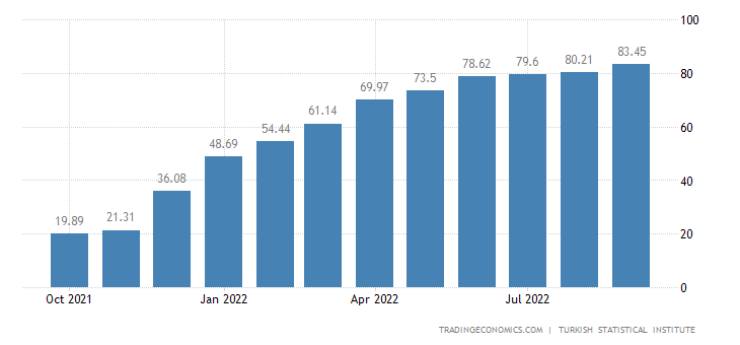
Official data released on Monday, 3/10/2022, showed that Turkey's annual inflation jumped to a new peak, representing the highest level in 24 years at 83.45%. This rate was lower than expected, after the Central Bank of Turkey surprised markets by cutting interest rates twice in the past two months despite rising prices.
How many living rooms are in the apartment?

According to the data, annual inflation in Turkey accelerated for the sixteenth consecutive month to reach 83.45% in the ninth month of 2022, compared to 80.2% in the eighth month of the same year, according to data from the Turkish Statistical Institute.
Below is a chart showing the trajectory of the inflation rate in Turkey during the period from November/October 2021 to September 2022:
Causes of Economic Inflation in Turkey
Analysis of the Turkish economy reveals that inflation in Turkey is caused by several factors, including:

- High interest rates: The interest rate in Turkey is high, even after being reduced to 12% in September 2022. High interest rates lead to increased production and service costs, especially if the economy relies heavily on bank credit.
- Decline in the value of the Turkish lira: The decrease in the purchasing power of the local currency increases demand-driven inflation. With oil prices expected to rise, this may prolong high inflation unless the Turkish government addresses other causes. Lowering interest rates may be one tool, but in Turkey's case, it needs to be gradual and consider a time frame that does not cause concern among savers and foreign currency holders.
- Global rise in energy prices: Among the weaknesses of the Turkish economy is its heavy reliance on energy imports, sometimes up to 90%. This has encouraged the country to generate energy from alternative sources (solar, thermal, wind, nuclear), and recently, natural gas reserves have been discovered in some Black Sea fields.
- COVID-19 pandemic: Like the rest of the world, the Turkish economy was affected by the global coronavirus crisis, which slowed trade, led to layoffs, and reduced production. The pandemic also negatively impacted tourism, an important sector for Turkey.
- The war in Ukraine: The Russian-Ukrainian war that began on February 24, 2022, worsened the overall situation and caused a major shock to the global economy. Turkey was significantly affected, according to Turkish economist Can Fuat Gürsel, who noted three direct impacts: high inflation due to supply shortages and increased demand, a decline in global trade, and a slowdown in economic activity.
- On the Turkish level, the economist points to the war's repercussions on the national economy, starting with a slowdown in domestic demand, decreased household purchasing power, rising energy and input costs, and supply problems, all negatively affecting the production of goods and services and causing economic growth to lose momentum.
- Private sector external borrowing: Experts note the Turkish private sector's heavy reliance on external financing. As of 2019, Turkey's external debt reached $440 billion, with the private sector accounting for about 65% of this debt, much of it short-term, creating ongoing and rapid pressure on demand for dollars.
- Rising US interest rates: This led to an increase in the dollar index, which raised the real value of Turkish imports.

The Decline of the Lira and Its Impact on Inflation in Turkey
Inflation in Turkey began to rise in the fall of 2021 when the Turkish lira experienced a sharp decline after the Central Bank of Turkey launched an easing cycle by cutting interest rates by 500 basis points.

The Turkish lira has been suffering from a continuous decline in value since 2014, due to a combination of political and economic factors, primarily regional circumstances that led the Turkish government to engage in several regional security issues and efforts to maintain state sovereignty.
Political conditions in Turkey since 2014 have also been unstable, including the failed military coup in 2016, early elections at various levels, and a constitutional referendum that changed the nature of the government system.
Undoubtedly, economic factors also played a significant role, such as the coronavirus pandemic and its impact on the tourism sector and real estate investment in Turkey. All these political and economic factors created instability and a continuous decline in the lira's value, contributing to rising inflation rates in the country.
Read also: Information about Real Estate in Turkey

Get a free real estate consultation
What is your preferred way of communication? How would you like to be contacted?

Get a free real estate consultation
Choose the appropriate day for us to contact you
How Has Economic Inflation Affected Living in Turkey?
Due to the economic inflation in Turkey, Turkish citizens suddenly found themselves facing a new wave of soaring prices, experiencing a dramatic increase in prices with relatively stable or slowly growing wages and salaries. This coincided with growing concerns about food security and the global food basket in light of recent developments.
In an effort to reassure Turkish citizens and encourage them to share responsibility with the state, the Turkish government implemented measures such as raising the minimum wage, significantly reducing taxes on basic goods, and offering discounts on some essential services.

How Has Inflation Affected Investment in Turkey?
Start a chat
Talk to us on your favorite channel







Regarding the impact of inflation on investment in Turkey, it does not seem to have significantly affected investment in Turkey. According to the “EY Attractiveness Survey Europe,” foreign investment in Turkey rose to 27% in 2021.
The report noted that "Turkey ranked fifth in Europe in attracting foreign direct investment projects."
According to the statement, "Turkey ranked fifth after France, the UK, Germany, and Spain."
Turkey is striving to become a global center for industry and export by leveraging the supply chain crisis caused by the coronavirus pandemic, especially given its central geographic location connecting Europe, Asia, and Africa.
Turkey also has the necessary infrastructure for supply, which has been developed through major transportation projects since 2002.
Are you ready to invest? Which apartment type do you prefer?
 Studio
 One bedroom
 Two bedrooms
 3 bedrooms or more
Select region
Turkey's share of global exports exceeded 1% for the first time in history in 2021.
You may also be interested: Inflation in Turkey and Its Impact on the Real Estate Market.
What Are the Ways to Hedge Against Economic Inflation in Turkey?
Taming inflation is a major and important challenge, but Turkey's experience after 2001 showed that, with the right policies, it can be done. In addition, foreign direct investment can recover by taking advantage of Turkey's position as a low-cost manufacturing hub on the doorstep of Europe.
According to observers, durable goods are considered a hedge against inflation, as new cars, white goods, or imported luxuries retain their value better than the lira, even if they are less liquid as a store of value, such as gold coins or dollar bonds.
We can recommend trying real estate investment in Turkey as a way to hedge against inflation. For more information and inquiries about the best real estate opportunities in Turkey, you can contact Imtilak Real Estate: your real estate consultant in Turkey.
You may also be interested: Apartments for Sale in Turkey with Government Guarantee
What Are the Economic Solutions to Limit Inflation in Turkey?
It is difficult for monetary policymakers to address inflation from both the supply and demand sides, but gradualism is required. One of the most important tools is building trust with the public, as the government seeks to achieve their interests, to address issues such as "dollarization" or hoarding.
How many living rooms are in the apartment?
It is also necessary to reduce the private sector's external borrowing, focus on participatory financing, give more space to Islamic finance, and encourage people to avoid foreign currency and limit transactions to the local currency.
Among the urgent solutions experts say the government must act on quickly: reconsidering the minimum wage, adjusting all long-term collective agreements, granting retirees an increase above the inflation rate, and resolving the issue of 3600 additional indicators as soon as possible.
As for Turkish companies, Turkey has a history of high inflation, and business owners have become experts in dealing with financial disruptions. Companies in Turkey have gained enough experience to adapt to the weak lira since 2018, with many seeking to reduce their dollar debts and taking necessary measures to cope with inflation.
Edited by: Imtilak Real Estate©
Get a free real estate consultation
What is your preferred way of communication? How would you like to be contacted?
Get a free real estate consultation
Choose the appropriate day for us to contact you
Did you like our topic? You can share it with your friends!
Do you like this topic? You can share it with your friends now!


Do you like this topic? You can share it with your friends now!
Need real estate help?
Consult with our specialist







Call center
Available now
The consultation is completely free