Financing Property in Turkey: Mortgages & Islamic Loans for Pakistani Buyers
2025-09-17
7,424 Views



- Introduction
- Can Foreigners Get a Mortgage in Turkey?
- Conventional Mortgages from Turkish Banks
- Islamic Mortgage Options in Turkey
- Comparison Table: Conventional vs. Islamic Mortgages
- Documentation Required for Pakistani Buyers
- Real-Life Example – Pakistani Investor in Istanbul
- Key Tips for Pakistani Investors
Introduction
Over the past decade, Turkey has grown into one of the top real estate destinations for international investors—especially for Pakistani nationals seeking both lifestyle and investment opportunities. Whether you're looking to buy a property for permanent residence, vacation, or rental income, understanding how to finance your real estate purchase in Turkey is essential.
In this article, we provide a comprehensive overview of property financing options in Turkey, tailored specifically for Pakistani buyers, including conventional Turkish mortgages and Islamic mortgage alternatives like Murabaha financing. We'll explore eligibility, process details, required documentation, and key benefits of each model—ensuring you’re fully informed and ready to make your investment confidently and in line with your financial or ethical preferences.
Can Foreigners Get a Mortgage in Turkey?
Yes, they can. Turkish laws allow foreigners, including Pakistani citizens, to purchase real estate and obtain financing from Turkish banks. While the process is slightly more detailed for non-residents, Turkey mortgages for foreigners have become increasingly accessible thanks to regulatory reforms aimed at attracting international buyers.
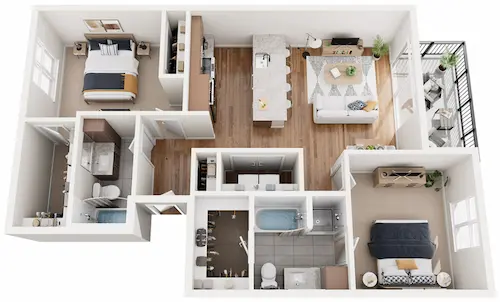
How many living rooms are in the apartment?

Highlights:
- Foreigners can typically borrow up to 50–70% of the property's value.
- Loan tenures usually range from 5 to 20 years.
- Mortgages are primarily available in Turkish Lira (TRY), though some banks may offer options in USD or EUR.
- The property must be legally registered with a clean title deed (Tapu) and suitable for individual ownership.

Conventional Mortgages from Turkish Banks
Several Turkish banks offer traditional home loan solutions for foreigners, including Pakistani nationals. These mortgages are based on interest-bearing systems, suitable for those who do not require Sharia compliance.
Eligibility Requirements:
- Valid passport.
- Turkish tax number (easily obtained at any tax office).
- Proof of income or employment documents (translated and notarized).
- Appraisal report of the selected property.
- Minimum 30–50% down payment depending on the bank's policy.
Process Overview:
- Pre-Approval:
You begin by submitting your identity documents, income proof, and tax number to the bank. This helps assess your eligibility and determine your borrowing capacity. - Property Appraisal:
Once you've selected a property, the bank assigns a licensed evaluator to determine its fair market value—this valuation directly impacts the maximum loan you can receive. - Loan Approval & Contract:
If the financial review is successful, the bank issues a formal approval. The mortgage agreement is then prepared and signed, typically in the presence of a notary. - Tapu Transfer & Registration:
After finalizing the loan, the title deed (Tapu) is transferred to your name. The mortgage is officially registered with the Turkish Land Registry to secure the bank’s interest.
Typical Costs:
- Annual interest rates range from 3% to 6%, depending on inflation and central bank policy.
- Loan processing fees (1%–2% of loan amount).
- Property insurance and valuation fees are required as part of the mortgage process.
Islamic Mortgage Options in Turkey
For investors seeking Sharia-compliant financing, Turkey has a well-established Islamic banking sector. These banks, known as participation banks (Katılım Bankaları), avoid interest (Riba) and offer alternatives like Murabaha, Ijara, and Musharakah Mutanaqisah.
Get a free real estate consultation
What is your preferred way of communication? How would you like to be contacted?

Get a free real estate consultation
Choose the appropriate day for us to contact you
- Murabaha Financing (Cost-Plus Sale)
Murabaha is the most widely used Islamic financing model in Turkey. Here's how it works:
- The bank purchases the property directly from the seller.
- It then resells the property to you at a pre-agreed profit margin.
- You repay the bank in fixed monthly installments over the agreed term.
Benefits:
- Fully Sharia-compliant, with no interest involved.
- Transparent pricing, with all profit margins disclosed upfront.
- Fixed payment schedule offers financial predictability.
Start a chat
Talk to us on your favorite channel







- Ijara (Lease-to-Own)
Though less commonly used, Ijara is another Islamic financing option. The bank buys the property and leases it to you for a defined period, during which you make rent payments. Ownership is transferred to you upon final payment. This model may require more documentation and negotiation with the bank.
- Leading Islamic Banks Offering Property Finance:
- Kuveyt Türk Participation Bank
- Albaraka Türk
- Ziraat Katılım Bankası
- Vakıf Katılım
These banks have experience serving Pakistani and Middle Eastern clients and offer English-speaking (and occasionally Urdu-speaking) support.
Are you ready to invest? Which apartment type do you prefer?
 Studio
 One bedroom
 Two bedrooms
 3 bedrooms or more
Select region
Comparison Table: Conventional vs. Islamic Mortgages
|
Feature
|
Conventional Mortgage
|
Islamic Mortgage (Murabaha)
|
|
Basis
|
Interest-based lending
|
Trade-based cost-plus sale
|
|
Sharia Compliance
|
Not compliant
|
Fully compliant
|
|
Monthly Payments
|
Includes interest
|
Fixed markup, no interest
|
|
Ownership Transfer
|
Immediate
|
Immediate
|
|
Preferred By
|
General investors
|
Muslim investors
|
Documentation Required for Pakistani Buyers
Whether you choose conventional or Islamic property financing, Pakistani buyers must prepare the following documents:
- Passport copy with notarized Turkish translation.
- Turkish tax number (can be obtained in minutes at local tax offices).
- Proof of income, such as bank statements, salary slips, or employment verification.
- Preliminary sales contract (if you've already selected a property).
- Property appraisal report ordered by the bank.
- Proof of address (such as utility bills or a tenancy contract if applicable).
Most banks require these documents to be translated into Turkish and notarized before submission. Your income level and debt capacity will be assessed carefully, especially when using Murabaha or long-term repayment plans.
Real-Life Example – Pakistani Investor in Istanbul
Consider the example of Mr. Ahmed, a Pakistani citizen working in the UAE. He identified an investment property in Başakşehir, Istanbul, worth $120,000. Wanting to remain compliant with Islamic principles, he approached Kuveyt Türk Participation Bank, who offered a Murabaha financing deal.
The bank purchased the apartment and resold it to Mr. Ahmed for $135,000, with repayment terms of 10 years and fixed monthly installments. He completed the transaction within three weeks, thanks to a real estate consultant experienced in Islamic financing.
Key Tips for Pakistani Investors
How many living rooms are in the apartment?
Work with Professional Real Estate Advisors
Hire a licensed consultant who understands both the Turkish property market and Islamic financing procedures. Language support (English/Urdu) is a plus.
Pre-Qualify with Banks
Get pre-approved before selecting a property. This helps streamline the transaction and ensures clarity on your budget.
Watch for Currency Risk
Get a free real estate consultation
What is your preferred way of communication? How would you like to be contacted?
Get a free real estate consultation
Choose the appropriate day for us to contact you
If you're earning in PKR or USD and borrowing in Turkish Lira, keep in mind that exchange rate fluctuations can affect your monthly payments.
Don’t Forget Additional Costs
Besides your down payment, you’ll need to budget for title deed transfer fees, appraisal, insurance, and possibly legal fees.
Contact Imtilak – Your Trusted Real Estate Partner in Turkey
Are you a Pakistani investor looking to buy property in Turkey with peace of mind and financial clarity?
Whether you're aiming for an Islamic mortgage or a conventional loan, Imtilak Real Estate is here to help you navigate the entire real estate process. From selecting the right property, obtaining your Turkish tax number, dealing with banks, and handling documentation, we provide end-to-end support tailored for Pakistani clients.
Contact us today for a free consultation, and let’s help you turn your vision of owning property in Turkey into reality—with transparency, integrity, and professionalism.
Do you like this topic? You can share it with your friends now!


Do you like this topic? You can share it with your friends now!
Need real estate help?
Consult with our specialist